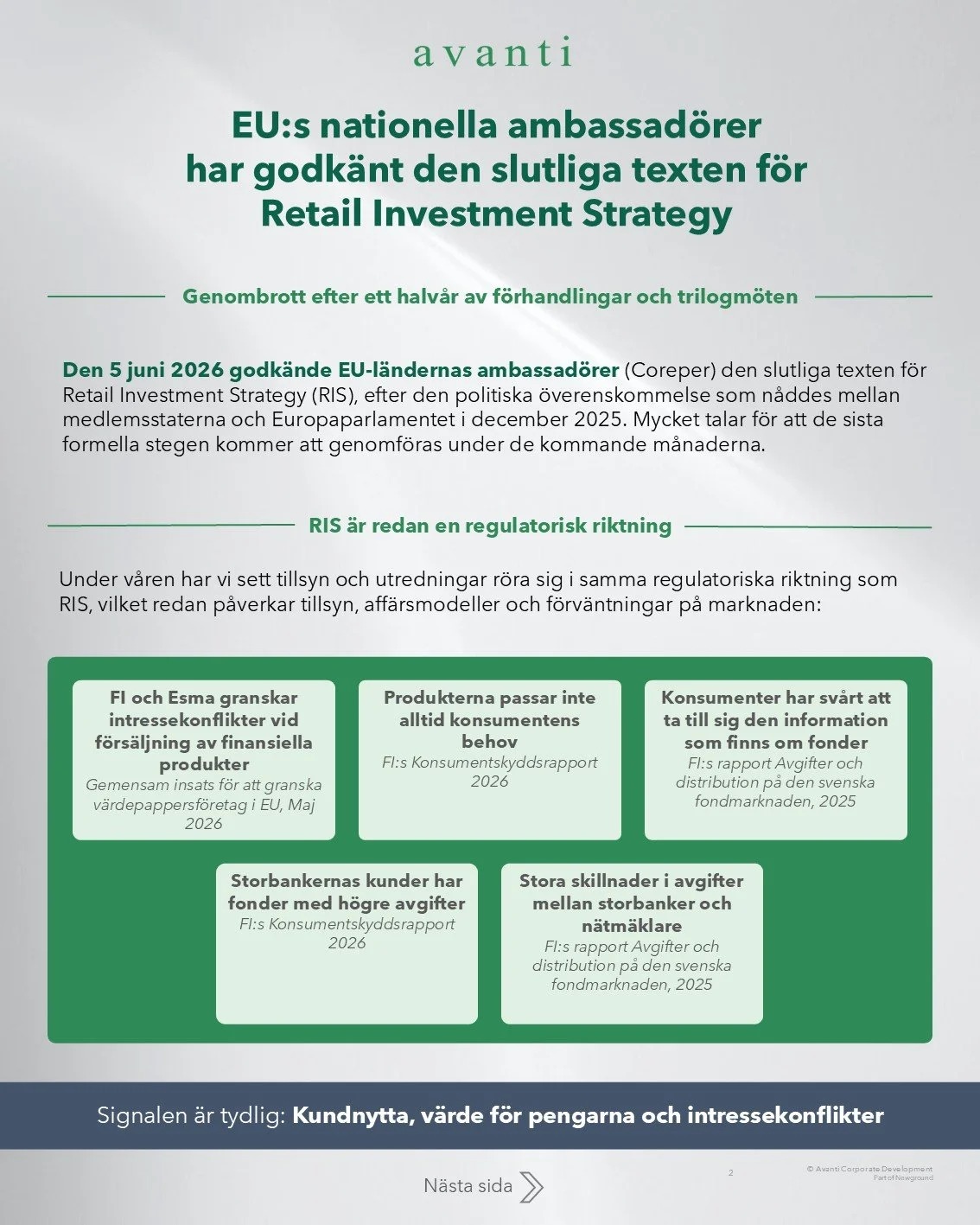
On 5 June 2026, EU ambassadors (Coreper) approved the final text of the Retail Investment Strategy (RIS), following the political agreement reached in December 2025. The Swedish government has also launched an inquiry into how RIS will be implemented in Swedish law. The final formal steps now appear close.
The direction is already clear
Supervision and inquiries are already moving in the same direction as RIS. Finansinspektionen (the Swedish FSA) and ESMA are reviewing conflicts of interest in the sale of financial products. FI’s reports point to products that don’t always match consumers’ needs, fund information that is hard for consumers to use, and large fee differences between major banks and online brokers. The signal is clear: customer benefit, value for money and conflicts of interest. The proposed ban on inducements has been dropped, but the direction is the same.
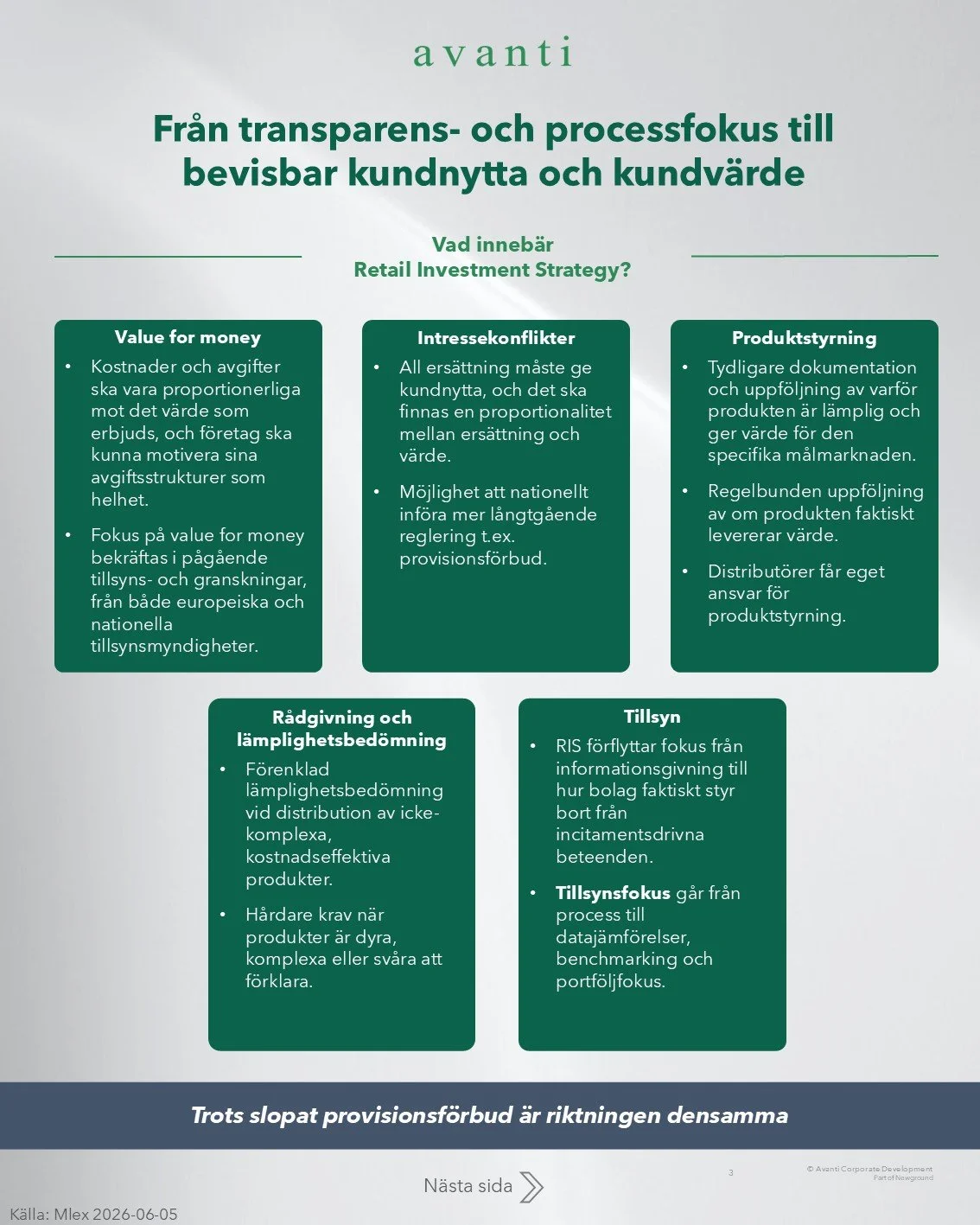
What RIS means
Value for money: Costs and fees must be proportionate to the value offered, and firms must be able to justify their fee structures.
Conflicts of interest: All inducements must benefit the customer, and member states may introduce stricter national rules.
Product governance: Clearer documentation and regular follow-up of why a product suits its target market and delivers value.
Advice and suitability: Simpler assessments for non-complex, cost-efficient products, and stricter requirements for products that are expensive, complex or hard to explain.
Supervision: The focus shifts from process to data comparisons, benchmarking and portfolio outcomes.
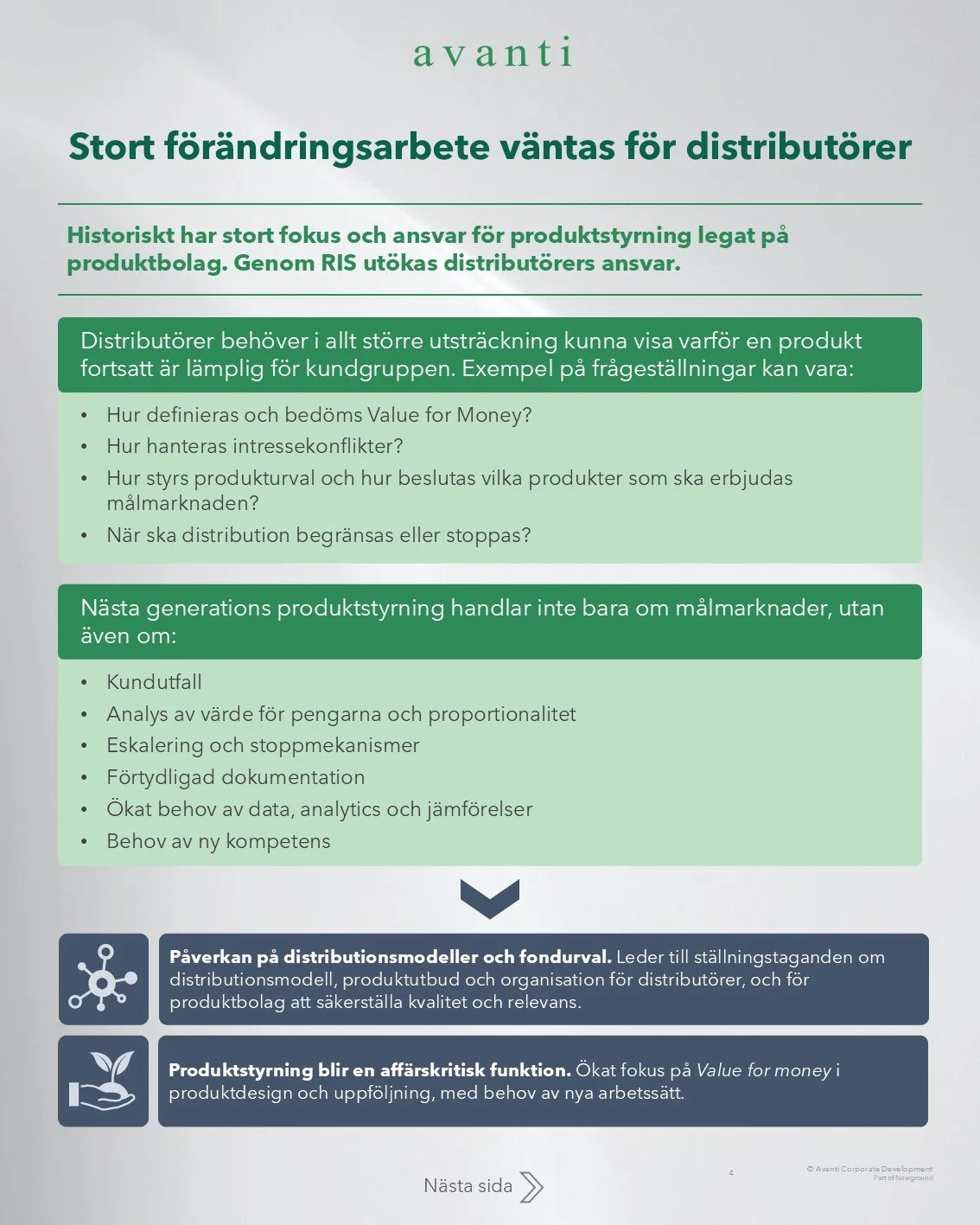
Major changes ahead for distributors
Product governance used to be mainly the product manufacturers’ responsibility. With RIS, distributors take on more of it. They will need to show why a product remains suitable for its customer group: how value for money is assessed, how conflicts of interest are managed, how products are selected, and when distribution should be restricted or stopped. This will affect distribution models and fund ranges, and product governance becomes a business-critical function that needs better data, analytics and new skills.
How will RIS affect your business?
Avanti has deep experience in the financial sector and a strong understanding of both regulatory requirements and market practice. We help you interpret and implement RIS in a way that strengthens both compliance and business value. Contact Melina Stenkil (melina.stenkil@avanti.se), Christian Rutz (christian.rutz@avanti.se) or Tomas Dahlqvist (tomas.dahlqvist@avanti.se).
Read more about how we support financial institutions with regulatory change on our Regulatory Advisory page.