
Core System Modernization in Insurance | The Backbone of Business-Driven Development
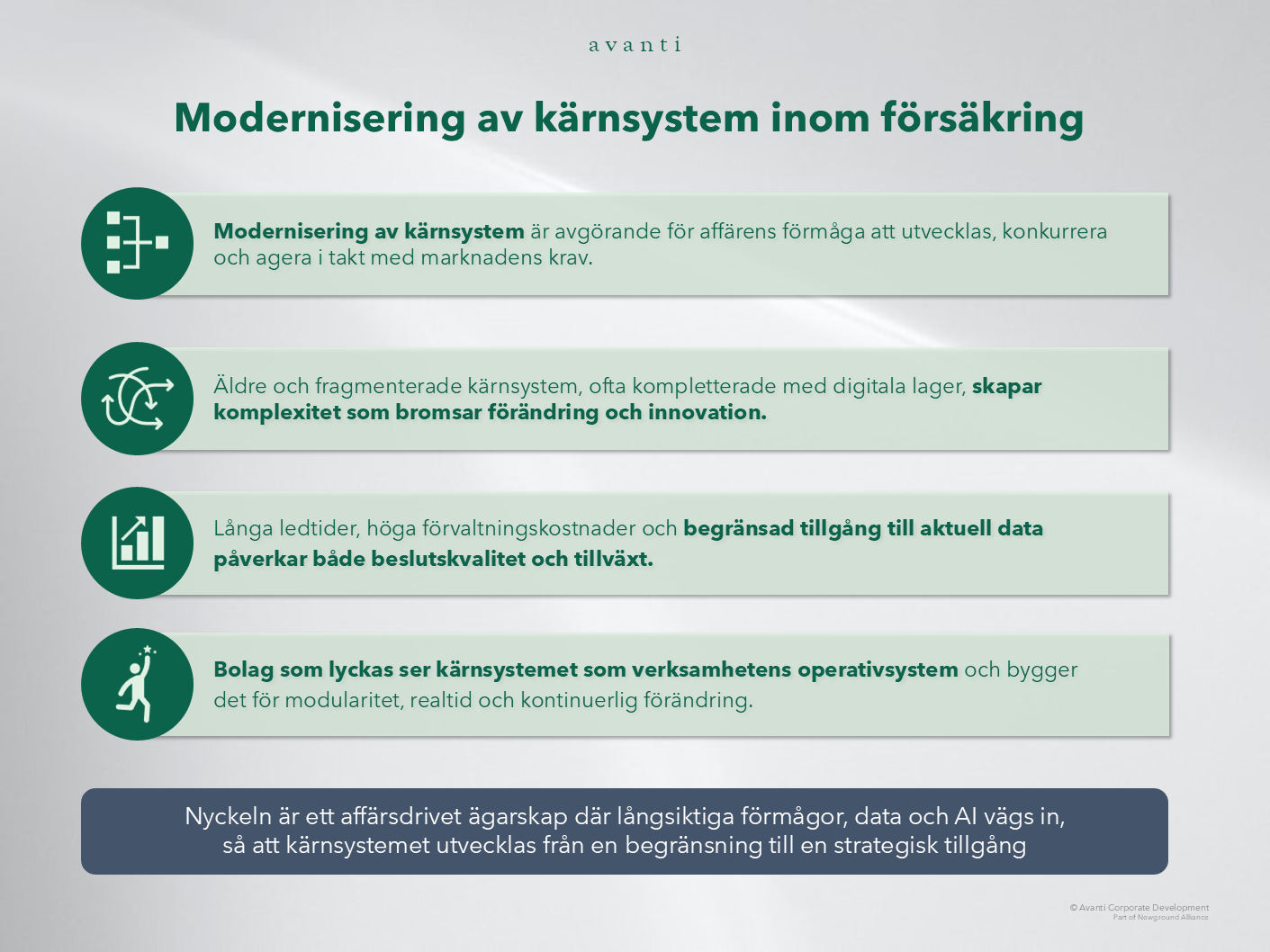
Core system modernization in insurance has become one of the most critical challenges facing insurers today. Many organizations experience that change takes longer and costs more than it should. Outdated technology, launching new products, adjusting policy terms, or updating pricing often requires extensive effort, despite clear business needs and strong strategic intent.
At the center of this challenge are insurance core systems. While they form the operational backbone of the business, they increasingly limit insurers’ ability to adapt, innovate, and scale.
The role of core systems in insurance
Core systems manage products, risk, pricing, policies, claims, and billing. Many of these systems, however, were designed for an environment characterized by stability, limited product variation, and low change frequency. As a result, they remain reliable, but difficult to change.
In practice, this has led to fragmented application landscapes, where multiple core systems coexist across products, geographies, or business lines. To address new requirements, insurers have often layered digital front ends and supplementary solutions on top of existing cores. While this may improve customer experience at the surface, it rarely addresses the underlying constraints of the core. In many cases, complexity increases rather than decreases.
Why core system modernization is a business issue, not just an IT initiative
The challenge of core system modernization is not purely technical. Too often, modernization is treated as an IT initiative, despite its deep and far-reaching business implications. Dependency on legacy platforms fosters risk aversion, leading organizations to incremental fixes and short-term compromises.
At the same time, batch-based processes, fragmented data, and weak data governance limit insurers’ ability to operate in real time (or ‘near real time’) and fully leverage data and AI. This constrains digital enablement and reduces the business impact of innovation initiatives.
Read more about Avanti’s perspective on Digital Enablement
Business consequences of legacy core systems
The consequences are clear:
Long time-to-market for new products and changes
IT budgets tied up in maintenance rather than innovation
Decisions based on delayed or incomplete information
At a strategic level, legacy core systems make it difficult to scale digital initiatives and apply new technologies where they create real business value. For many insurers, core systems therefore become a central topic on the executive agenda.
Explore how Avanti works with Strategy
How leading insurers approach core system modernization
There is a clear pattern among insurers that succeed with core system modernization:
Core systems are treated as the operating system of the business, not as back-office support
Focus shifts from customization to configuration and modularity
Batch processing gives way to real-time (or ‘near real time’) flows
Differentiation increasingly happens on top of the core, while the core itself is designed for stability, flexibility, and continuous evolution. This requires an integrated view across business, architecture, and technology.
Learn more about Avanti’s work within Applied Tech Advisory
From constraint to strategic asset
Equally critical is clear, business-driven ownership. Successful core system modernization is less about selecting the “right” system and more about understanding the long-term implications of different strategic choices.
Insurers that start from their long-term business capabilities, embed data and AI into core operations, and combine technical modernization with organizational change are far better positioned to transform their core systems from a constraint into a strategic asset.
At Avanti, we help insurers understand their core system challenges and define viable paths toward future-proofing the business.
Learn more about our work in Insurance or contact us to continue the conversation.